Buying Guide
Electric Bike Buying Guide: How to Choose, by the Numbers
An electric bike buying guide built on 669 tracked models: the six decisions that matter, real median prices by type, and how to read a range claim.
The Data Desk Jul 11, 2026 6 min read
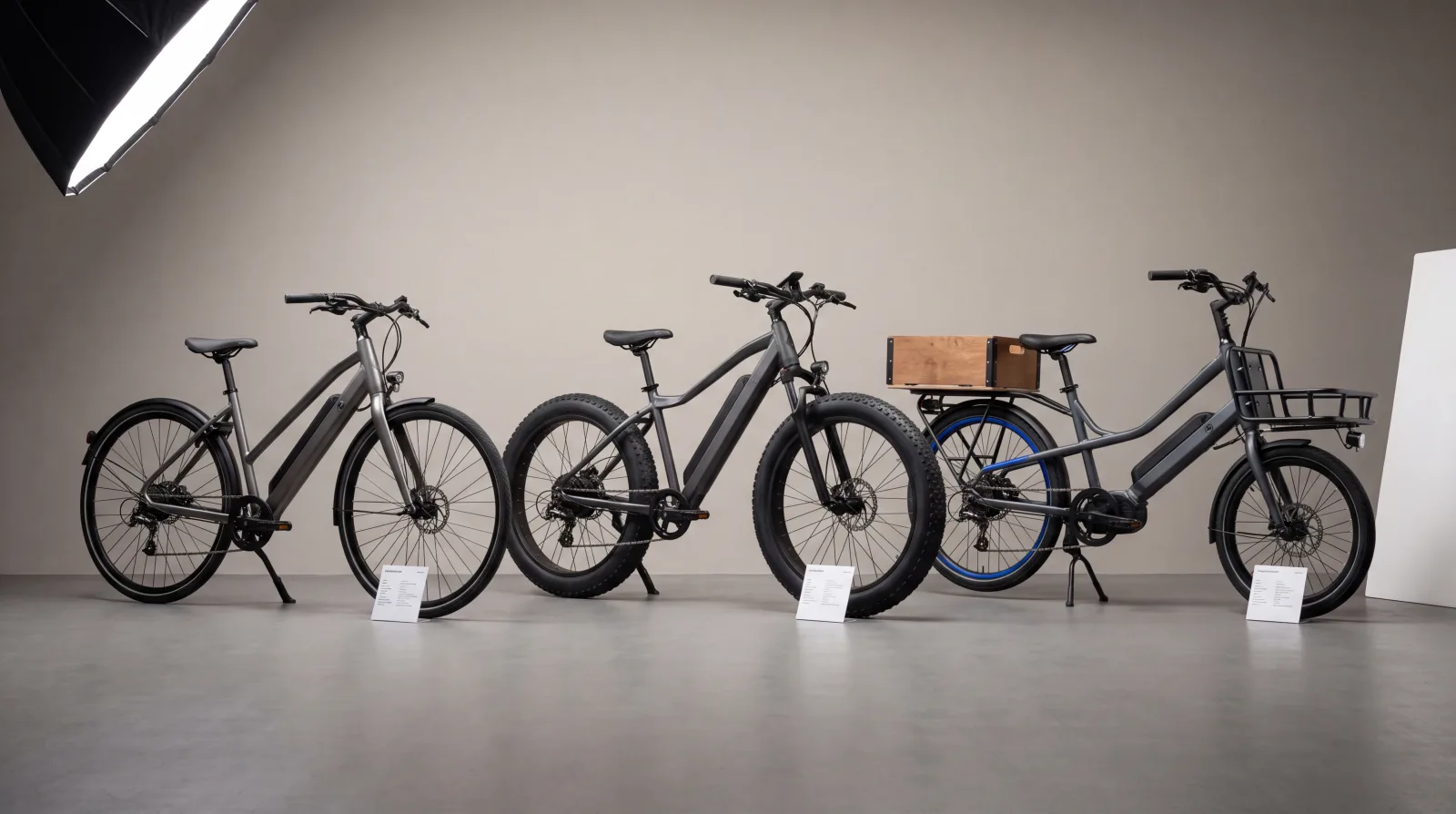
Buying an e-bike comes down to six decisions: class, power, range, budget, fit, and where you buy. Across the 669 models we track, the median sells for $2,373 CAD (about $1,599 USD), and the price splits hard by type: a folding commuter runs around $1,800 CAD, a cargo bike about $6,399. The rest is matching the machine to your ride. Every number below is computed from our catalog, not copied off a spec sheet. Two decisions carry the most weight — whether the motor is legal where you ride, and how a range claim compares to its own battery.
The six decisions, in order
Most buying advice is a feature tour. This is a decision order, because the choices constrain each other: your class decides where it is legal, power decides the class, budget decides the type, and the type decides almost everything else. Work top to bottom.
1. Class: where you are allowed to ride
Class is the legal wrapper, not a spec. North American e-bikes fall into three classes: Class 1 (pedal-assist to 20 mph), Class 2 (throttle to 20 mph), and Class 3 (pedal-assist to 28 mph). Which classes are welcome on a path, and at what age, is set locally — the province or the state, sometimes the city.
Two facts decide most of it: the motor’s rated power and the speed it will still assist you. Canada’s federal reference is 500 W and 32 km/h; most US states use the 750 W, three-class model. Read your own jurisdiction before you buy — the rules are laid out region by region in the rulebook.
2. Power: the number that sets the class
Motor power is where legal and physical meet. Of the machines in our index that publish a motor rating, the median is 750 W. But 56% of them exceed Canada’s 500 W nominal ceiling in at least one mode, and 40% exceed 750 W. A bigger motor climbs better and hauls more; it also burns the battery faster and can push the bike out of the class you are allowed to ride.
The wattage on the box is not the whole story — nominal and peak ratings differ, and the shelf is not consistent about which one it prints. We pulled that thread apart in The 750-Watt Question.
3. Range: read the claim against the battery
Range is the most oversold number on any e-bike. Of the 296 machines in our index that publish a range claim, the median claim is 126 km. Set against the battery each one carries, at the 20 Wh/km midline we use across the index, the median claim runs about 198% past what the battery math supports. The claim is roughly triple the physics for the typical bike.
This is not one brand lying; it is the whole shelf quoting a best case. Judge range by the battery, in watt-hours: a 500 Wh pack supports roughly 25 km of hard assist and 33 km of gentle riding, whatever the sticker says. The full audit is The Range Lie.
4. Budget: what real money buys
Across the 343 models with a live Canadian price, the middle half sell between $925 and $4,049 CAD, with the median at $2,373. Where you land in that spread is mostly a function of type, not brand:
| Type | Models priced (CAD) | Median price |
|---|---|---|
| Cargo | 15 | $6,399 |
| Mountain | 29 | $5,199 |
| Trike | 5 | $3,599 |
| Road | 10 | $3,449 |
| Commuter | 139 | $2,799 |
| Folding | 11 | $1,800 |
| Scooter | 26 | $1,499 |
| Dirt / off-road | 92 | $999 |
| Fat-tire | 16 | $625 |
Prices are the lowest live Canadian offer per model; CAD and USD are never mixed. The lesson is to set the budget after the type, not before: a $2,000 budget is generous for a folding commuter and short for a cargo hauler. The full board sits in the database, filterable by price.
5. Fit and safety
Fit is not computable from a catalog, so we will not pretend it is. Sit on the bike if you can; you want to reach the pedals with a slight bend and stand over the frame flat-footed. Two safety checks are worth making before you pay: the battery should carry a UL 2849 (or EN 15194) certification mark, and the brakes on anything Class 3 or heavy should be hydraulic discs, not mechanical.
6. Where you buy
The same machine is rarely one price. Of the 714 live offers we track, 44% sit below the retailer’s own earlier price, at a median cut of 20%. Buying at a genuine markdown is the single easiest way to move down a budget bracket without moving down a class of bike. We rank every storefront on catalog breadth and honest discounting in the merchants index, and surface the live cuts in the market report.
Frequently asked questions
How much should I spend on my first e-bike?
Enough to clear the type you need. The median tracked e-bike is $2,373 CAD, but that blends a $625 fat-tire median with a $6,399 cargo median. Pick the type first, then expect to pay near that type’s median for a machine with a certified battery and disc brakes. Below a type’s floor, you are usually buying a lighter battery and weaker brakes.
What class of e-bike do I need?
For most riding, Class 1 or Class 2 to 20 mph is enough and is welcome on the widest set of paths. Choose Class 3 (28 mph) only if you commute in traffic and your local rules allow it — several places set a minimum age and require a helmet for Class 3. Confirm in the rulebook for your region before buying.
Are cheap e-bikes worth it?
Sometimes, at a genuine markdown; rarely, at a suspiciously low list price. A cut from a retailer’s own earlier price is real value — 44% of tracked offers carry one. A bike priced far under its type’s median usually saves money on the two parts you should not cut: the battery certification and the brakes.
How do I judge a range claim?
Ignore the headline and read the battery. Divide the watt-hours by about 20 for a realistic assisted range in kilometres, or by 15 for the gentlest best case. If the claim is more than double that best case, it is beyond the physics of its own battery — and across our index the median claim is roughly triple the midline.
The bottom line
Buy in this order: pick the class the law allows, the type that fits your ride, then the best-specified machine near that type’s median price — ideally at a real markdown, with a certified battery and disc brakes. Skip anything whose range claim is more than double its battery math, and confirm the motor is legal where you ride. When you are ready to compare specific machines, the receipts live in the database, the value rankings in the boards, and the live deals in the market report.