Guide
How Do Ebikes Work? Battery, Motor, and Sensor Basics
How do ebikes work? A pedal sensor tells a controller to feed battery power into the motor. Grounded in 669 tracked models and their real specs.
The Data Desk Jul 11, 2026 6 min read
Quick answer
An e-bike adds four parts to a normal bicycle: a battery, a controller, a motor, and a sensor. When you pedal, the sensor reads your effort or your pedalling speed. It signals the controller, which meters electricity from the battery into the motor. The motor then adds torque at the crank or the rear wheel. Power stops when you stop pedalling or hit the legal speed cap. Across our 669 tracked models, the median motor is 750 watts (of the 407 that publish a rating) and the median battery holds 749 watt-hours. That battery, at a realistic 20 watt-hours per kilometre, covers roughly 37 assisted kilometres.
The four parts that make a bike electric
Every e-bike shares the same signal chain. Understanding it makes spec sheets readable.
| Part | Job | Typical unit |
|---|---|---|
| Battery | Stores energy | Watt-hours (Wh) |
| Controller | Meters power on demand | Amps / watts |
| Motor | Converts power to torque | Watts (W) |
| Sensor | Detects that you are pedalling | (trigger only) |
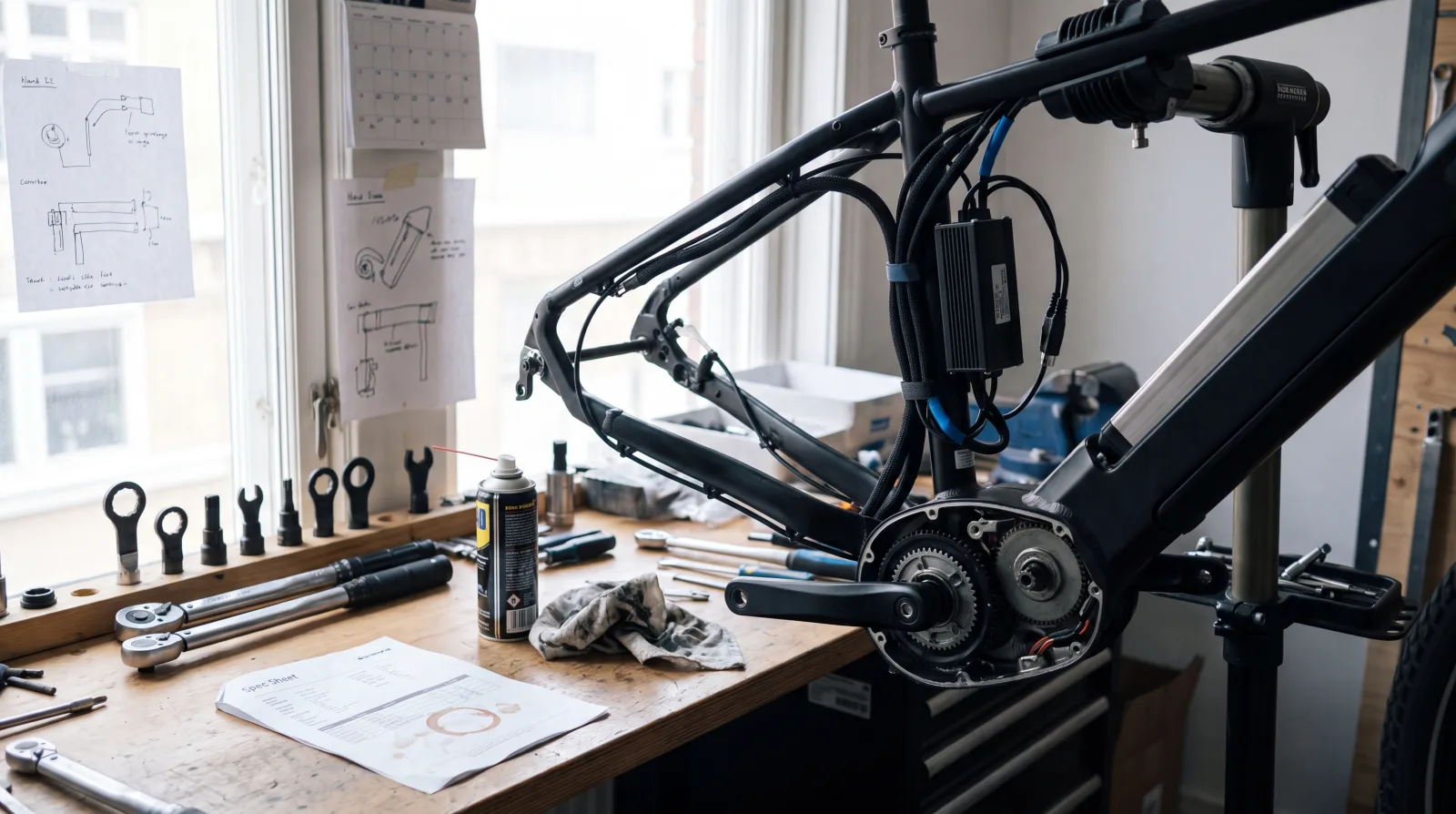
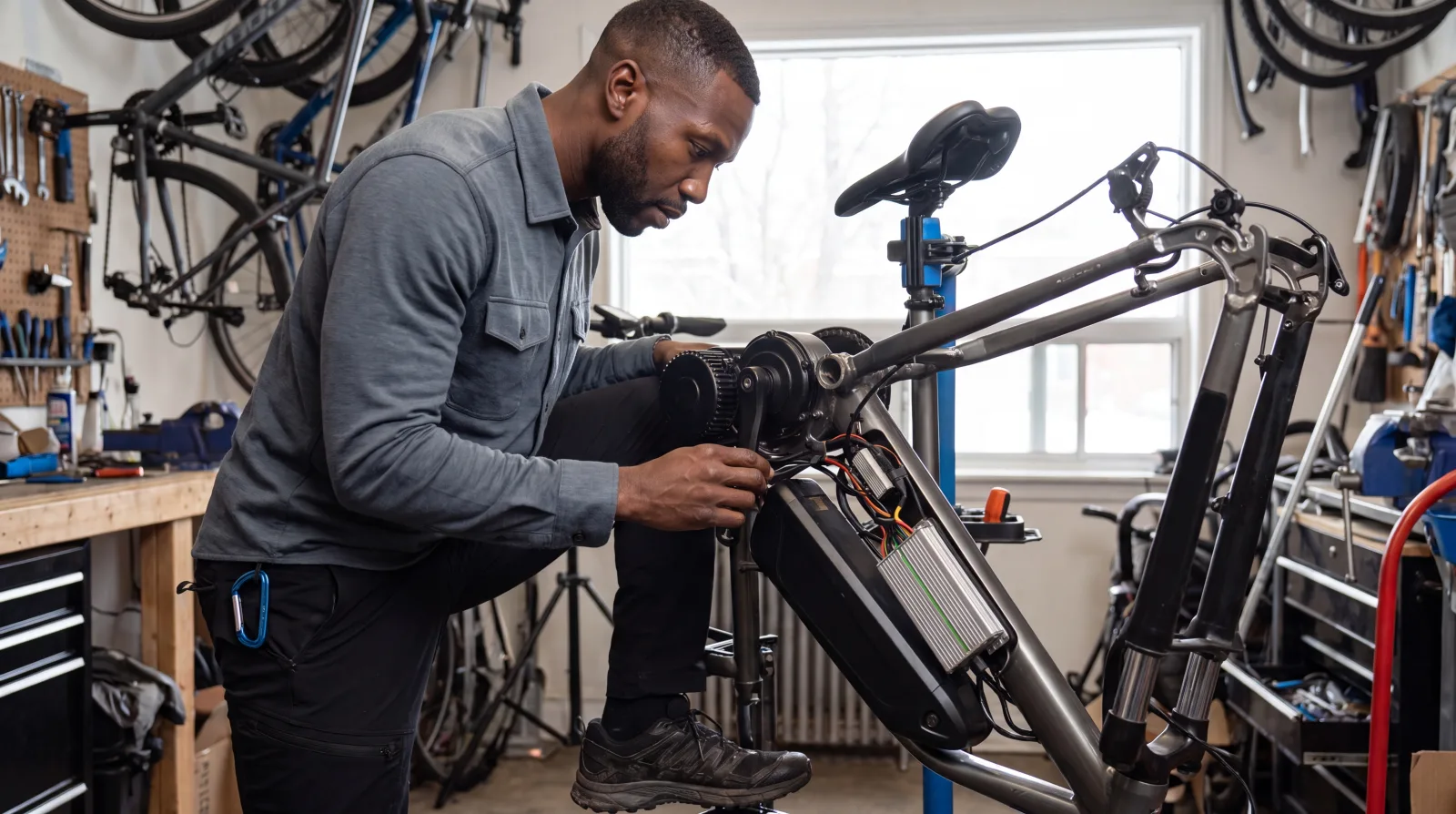
The battery is the fuel tank. Its watt-hour number, not its voltage, predicts range. The controller is the brain: it decides how much current reaches the motor at any moment. The motor is the muscle, mounted either at the rear hub or at the crank (a mid-drive). The sensor is the trigger that starts the whole sequence.
What the sensor actually does
Two sensor types dominate, and they feel different.
A cadence sensor detects only that the cranks are turning. Pedal at all, and assist switches on at a preset level. It behaves like a throttle tied to motion.
A torque sensor measures how hard you push, then scales assist to match. Push harder, get more. It feels like a stronger version of your own legs.
Our catalog does not record which sensor each model uses, so we state no share here. Read the product page: torque sensors are common on commuter and mid-drive bikes and usually cost more.
How much power the motor delivers
Motor rating sets how much help you get on hills and from a stop. Here is the spread across every model that lists one.
| Motor rating | Share of the 407 that publish a rating |
|---|---|
| Above 500 W | 56% |
| Above 750 W | 40% |
| Above 1000 W | 26% |
| Median rating | 750 W |
The median sits at 750 watts. Legal limits, not physics, explain that clustering. Canada’s federal reference caps assisted power near 500 watts and speed at 32 km/h. The US low-speed e-bike definition allows 750 watts and throttle assist to 20 mph.
So the median 750-watt bike is legal in the US but above Canada’s federal number. That gap is the reason so many buyers get confused. We unpack the number itself in The 750-Watt Question, and the class rules live in the rulebook.
How far a charge really goes
Range is the most inflated spec on any e-bike listing. The math is simple; the marketing is not.
Watt-hours divided by 20 gives a realistic assisted distance. Divide by 15 for the gentlest best case: light rider, flat ground, lowest assist.
| Range metric | Value |
|---|---|
| Models publishing a range claim | 296 of 669 |
| Median published claim | 126 km |
| Median battery capacity | 749 Wh |
| Realistic assisted (749 Wh ÷ 20) | ~37 km |
| Gentlest best case (749 Wh ÷ 15) | ~50 km |
The median published claim of 126 km runs about 198% above the 20 Wh/km battery-math midline. Read that as: the typical range claim is roughly triple what a normal rider should expect. Trust the battery’s watt-hour number over the headline kilometre figure. We show why the claims drift so far in The Range Lie.
Where power meets price
Bigger motors and batteries tend to cost more, and category signals that.
| Type | Median price (CAD) | Models |
|---|---|---|
| Cargo | $6,399 | 15 |
| Mountain | $5,199 | 29 |
| Commuter | $2,799 | 139 |
| Folding | $1,800 | 11 |
| Fat-tire | $625 | 16 |
Across the full catalog the median lowest live price is $2,373 CAD (n=343). Filter every spec yourself in the database, or scan live deals in the market.
Motor placement and class matter more to how a bike rides than any single number. We cover those choices in Types of Electric Bikes and E-Bike Classes Explained.
FAQ
Do you have to pedal an e-bike?
On a pedal-assist e-bike, yes: the sensor needs your cranks moving to trigger the motor. Some models add a throttle that drives the motor without pedalling. Whether a throttle is street-legal depends on your class and region. Check the rulebook before you buy, because throttle rules vary between Canada and the US.
What does the controller do?
The controller is the decision-maker between battery and motor. It reads the sensor signal and releases the right amount of current, moment to moment. It also enforces the speed cap: at the legal limit it cuts assist, so you keep the pedals turning under your own power. A bigger controller lets a motor draw more current, which is why watt ratings alone do not tell the whole story.
How is range calculated on a spec sheet?
Most brands quote a best case: lowest assist, flat road, light rider. Our data shows the median claim runs about 198% above a realistic battery-math estimate. To sanity-check any listing, take the battery’s watt-hours and divide by 20. A 749 Wh battery, the catalog median, yields roughly 37 assisted kilometres, not the 126 km a typical claim advertises.
Is a 750-watt motor legal in Canada?
Not under the federal reference, which points to about 500 watts and 32 km/h. The 750-watt figure comes from the US low-speed e-bike definition. Provinces set their own rules on top of the federal baseline, so a bike sold nationwide may not match your local limit. Confirm the specifics for your province in the rulebook.
Torque sensor or cadence sensor: which is better?
A torque sensor scales assist to how hard you pedal, so it feels natural and rations the battery well. A cadence sensor switches assist on the moment you move, which feels more like a push. Neither is wrong. Torque sensors suit riders who want a bicycle feel; cadence suits riders who want easy, steady help. The listing states which one a model uses.
The bottom line
An e-bike is a bicycle plus a battery, a controller, a motor, and a sensor that ties them together. If you are new, read two numbers first: the battery’s watt-hours and the motor’s watts. Divide the watt-hours by 20 for honest range, and match the motor rating to your region’s legal class. Skip the headline range claim. When you are ready to compare real models, start with the buying guide, then filter specs in the database.