Classes & Power
Ebike motors explained: hub vs mid-drive and 750 W
Ebike motors explained without jargon: hub versus mid-drive, why 750 W is the catalog median, and what the power number actually buys you.
The Data Desk Jul 11, 2026 6 min read
Quick answer
An ebike motor turns battery power into forward push. It sits in one of two places: the rear wheel hub, or the frame center at the pedals (mid-drive). Both move you. They differ in feel, gearing, and cost. Power is rated in watts. Across the 407 catalog models that publish a rating, the median is 750 W. More than half exceed 500 W. Wattage sets the ceiling, not the everyday feel: torque, gearing, and weight decide how a bike climbs. The number also carries legal weight, because class limits key off power and speed. Start with where the motor lives. Then read the wattage.
Hub or mid-drive: where the motor lives
Every ebike motor sits in one of two spots. That single fact predicts most of the price and feel.
A hub motor lives inside a wheel, usually the rear one. It drives that wheel directly. Fewer moving parts touch your chain, so it runs quiet and stays cheap to service. Hub drives dominate commuter and budget builds.
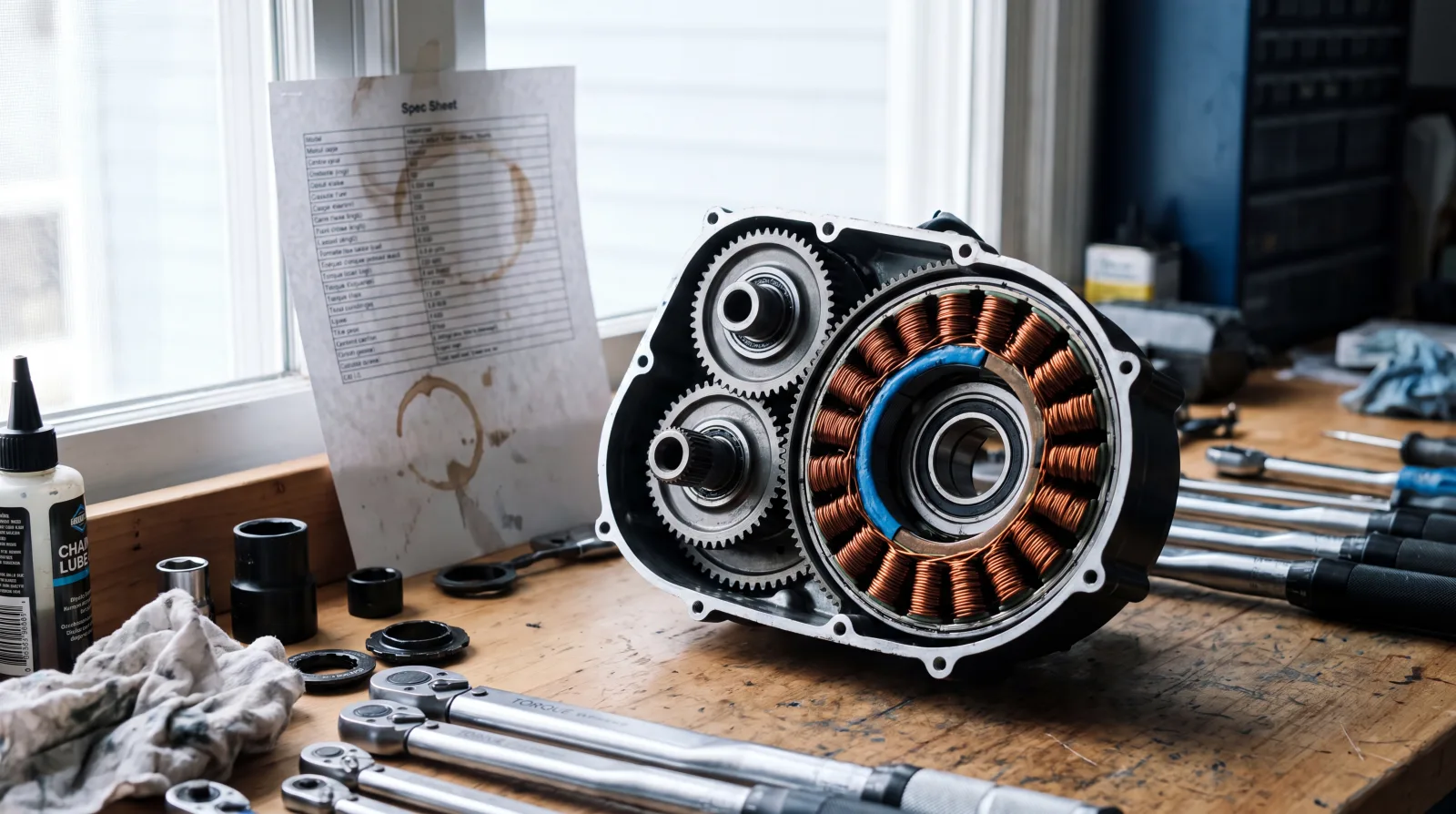
A mid-drive motor sits at the crank, where the pedals are. It pushes the chain, so it uses the bike’s own gears. That gearing lets it climb better and balance weight lower and more centered. It costs more, and it wears your chain faster.
Neither is universally “better.” The full trade-off, with climbing, service, and cost detail, lives in our hub motor vs mid-drive breakdown. For how power maps to legal categories, read ebike classes explained.
What the wattage number actually means
Watts measure how fast the motor can do work. A higher rating raises the ceiling for acceleration and hill-holding. It does not, on its own, decide how the bike feels at a gentle cruise.
One catch: the number on the spec sheet is a nominal, continuous rating. Many brands also quote a much larger “peak” figure for short bursts. The catalog does not track peak power, so treat any peak claim as a marketing number until you see the continuous rating beside it.
Across the 407 models that publish a rating, the median lands at 750 W. That number is not an accident. It matches the US federal ceiling for a low-speed ebike, so builders cluster around it.
| Motor rating | Share of the 407 rated models above it |
|---|---|
| Over 500 W | 56% |
| Over 750 W | 40% |
| Over 1000 W | 26% |
Read that table carefully. More than a quarter of rated models exceed 1000 W. Many of those are dirt and off-road builds not street-legal in most places. Our 750-watt question unpacks why the spec crept upward.
How power maps to legal classes
Power and speed decide which legal box a bike falls into. The catalog does not record each model’s class, so treat the framework below as the concept, then check your own region.
Most of North America uses a 3-class model. Class 1 and Class 2 assist up to 20 mph. Class 3 assists up to 28 mph. Canada’s federal reference caps a power-assisted cycle at 500 W and 32 km/h. The US federal low-speed ebike standard allows 750 W and 20 mph on the throttle.
A 750 W motor can be legal or not depending on how the bike is limited and where you ride. Provincial and state rules vary, and enforcement varies more. Confirm the specifics for your region in the rulebook before you buy.
Does more wattage mean more range?
No. A bigger motor pulls harder from the same battery, so at full power it can drain faster. Range depends on the battery, the terrain, and how much you pedal.
Battery energy is measured in watt-hours. The catalog median battery holds 749 Wh. A useful rule of thumb: watt-hours divided by 20 gives realistic assisted kilometres; divided by 15 gives the gentlest best case. So 749 Wh points to roughly 37 to 50 km of honest assisted riding, not the headline claim on the box.
The motor sets how hard that battery gets pushed. Pair a strong motor with a small battery and range suffers. To sort real specs by motor and battery, browse the database, or filter by riding style on the boards.
Frequently asked questions
Is a higher-wattage ebike motor better?
Not automatically. Wattage raises the ceiling for acceleration and climbing, but torque, gearing, and weight decide daily feel. A well-geared 500 W mid-drive can out-climb a heavier 1000 W hub bike. Higher power also drains the battery faster and can push a bike outside legal limits. Match the rating to your terrain and your local rules, not to the biggest number on the page.
What does the 750 W median actually get me?
Across the 407 rated catalog models, 750 W is the middle of the pack. It matches the US federal low-speed ebike ceiling, which is why builders cluster there. In practice a 750 W motor handles hills, cargo, and headwinds for most commuters. It is enough power that gearing and battery size, not raw watts, become the limiting factors for how the bike rides.
Hub motor or mid-drive for hills?
Mid-drive, in most cases. Because a mid-drive pushes the chain, it uses the bike’s gears, so it can multiply torque on a steep climb the way your legs do in low gear. A hub motor drives the wheel directly at a fixed ratio, so it can bog down on long, steep grades. For flat commuting, a hub motor is simpler and cheaper and does the job.
Are 1000 W ebike motors legal?
Often not, for on-road use. The US federal low-speed ebike standard caps power at 750 W. Canada’s federal reference sits lower, at 500 W. Of the 407 rated catalog models, 26% exceed 1000 W, and many are dirt or off-road builds meant for private land. Check the rulebook for your province or state before you assume a high-wattage bike is street-legal where you ride.
The bottom line
Read an ebike motor in two steps. First, find where it lives: a hub drive is simpler and cheaper, a mid-drive climbs better and costs more. Second, read the continuous wattage, not the peak. The catalog median is 750 W across 407 rated models, and that number matches the US legal ceiling for a reason.
This guide is for buyers narrowing a shortlist. Before you commit, confirm three things: the continuous rating (not peak), the battery watt-hours for honest range, and whether the bike’s power and speed are legal where you ride. New to the whole decision? Start with the electric bike buying guide, then check live pricing in the market.