Guide
Ebike vs Regular Bike: Speed, Effort, Cost Compared
The ebike vs regular bike difference: a motor and battery, assisted to 20-28 mph by class, at a median $2,373 CAD. Speed, effort, cost and range compared.
The Data Desk Jul 11, 2026 7 min read
Quick answer
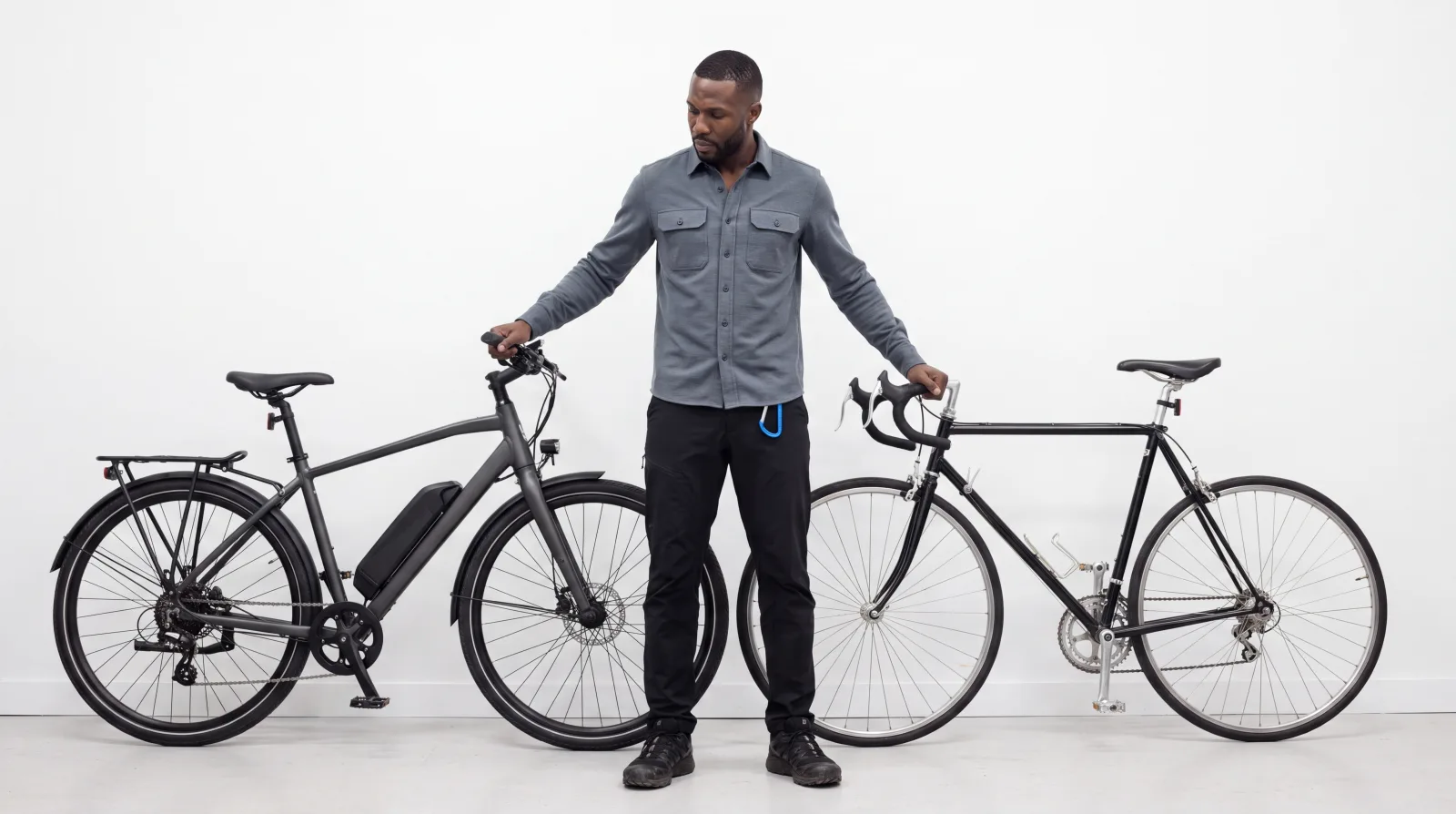
An ebike is a regular bike plus a motor and a battery. The motor assists your pedaling up to a class speed cap: 20 mph for Class 1 and 2, 28 mph for Class 3. A regular bike has no cap and no help. Across our catalog of 669 tracked models, the median ebike lists at $2,373 CAD, drawn from the 343 models with a live CAD price. A capable regular bike costs a fraction of that. The trade is simple. You travel faster and farther for less effort. You carry more weight, more maintenance, and a battery to charge. Below: speed, effort, running cost, maintenance, and health, side by side.
What actually changes: a motor and a battery
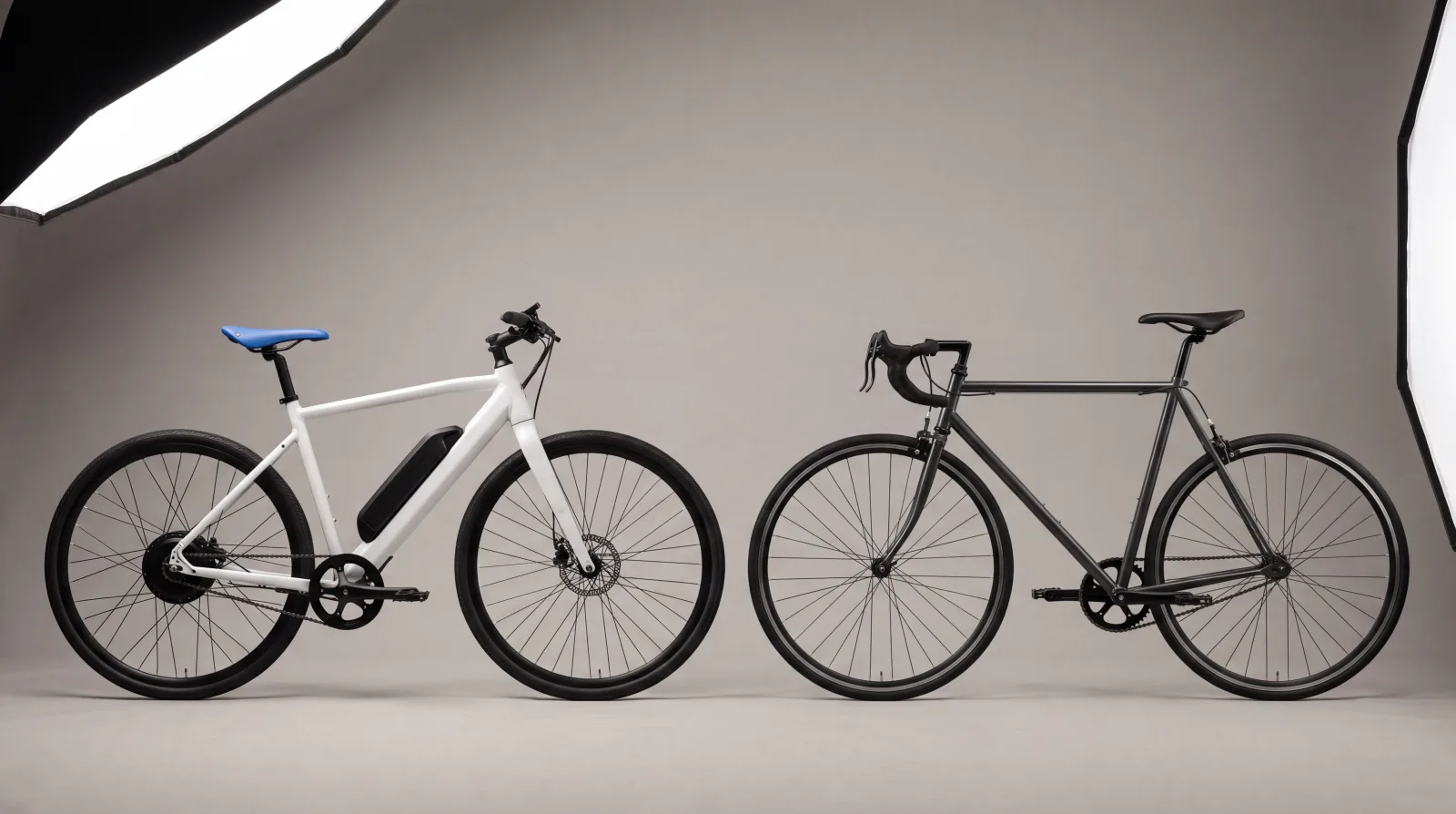
Strip away the marketing and one hardware difference defines the category. An ebike adds an electric motor at the wheel or the pedals, plus a battery to feed it.
That motor is not small. Of the 407 catalog models that publish a motor rating, the median is 750 W. More than half exceed 500 W. Forty percent exceed 750 W.
A regular bike outputs only what your legs produce, which for most riders sits well under the median 750 W motor. So the motor often more than doubles what reaches the road.
The assist is capped by law, not by the hardware. That cap defines the riding class. Browse the full spec set in the database, and read the legal detail in the rulebook.
How fast each one goes
Speed is where the gap is easiest to feel. A regular bike goes as fast as your legs and the terrain allow. An ebike holds a steady assisted speed until its class cap, then the motor backs off.
| Bike | Assisted top speed | Cap set by |
|---|---|---|
| Class 1 (pedal-assist) | 20 mph / 32 km/h | Class rules |
| Class 2 (throttle) | 20 mph / 32 km/h | Class rules |
| Class 3 (speed pedelec) | 28 mph / 45 km/h | Class rules |
| Regular bike | No cap | Your legs |
| Canada federal reference | 32 km/h | 500 W limit |
These are general reference figures. Provincial and state rules vary, so confirm your region in the rulebook. We explain the tiers in full in our ebike classes guide.
The practical effect: an ebike lets an average rider hold a speed that only a strong cyclist reaches on a regular bike. And it holds that speed uphill and into headwind.
What it costs to buy
This is the clearest disadvantage for the ebike. The median tracked model lists at $2,373 CAD, from the 343 CAD-priced models. A solid commuter-grade regular bike often lands well under a thousand.
Price also swings hard by type. Here is the median lowest live offer, CAD, by category.
| Type | Median price (CAD) | Models (n) |
|---|---|---|
| Cargo | $6,399 | 15 |
| Mountain | $5,199 | 29 |
| Trike | $3,599 | 5 |
| Road | $3,449 | 10 |
| Commuter | $2,799 | 139 |
| Folding | $1,800 | 11 |
| Scooter | $1,499 | 26 |
| Dirt / off-road | $999 | 92 |
| Fat-tire | $625 | 16 |
Compare models by category on the boards. Whether that price is justified for you is its own question, and we answer it in the buying guide. This page stays on what is different, not on the verdict.
Discounts move the real number. Of the 714 live offers we track, 44% sit below the retailer’s own earlier price. The median genuine cut is 20%. Watch the live spread on the market page.
What it costs to run
A regular bike costs almost nothing to run. Chain oil and the occasional tube.
An ebike adds electricity, but the amount is tiny. The median battery holds 749 Wh. A full charge draws under one kilowatt-hour. That is pennies at most Canadian rates.
The battery itself is the real running cost. It is a wear part with a finite lifespan. Budget for a replacement pack years down the road.
Effort and range: read the claims carefully
The effort story is the ebike’s strongest case. The motor flattens hills and shrinks headwind. You arrive without the sweat a regular bike demands.
Range is where the marketing gets loose. Of the 296 models that publish a range claim, the median claim is 126 km. That figure runs about 198% above the battery-math midline.
Here is the honest math. Divide watt-hours by 20 for realistic assisted kilometers. Divide by 15 for the gentlest best case. On the median 749 Wh pack, that is roughly 37 to 50 km, not 126.
| Method | Basis | Result on 749 Wh |
|---|---|---|
| Median published claim | Marketing | 126 km |
| Realistic assisted | Wh / 20 | ~37 km |
| Gentlest best case | Wh / 15 | ~50 km |
A regular bike has no such number, because it has no battery to run flat. Read the full breakdown in The Range Lie.
Maintenance: more parts, more to check
More systems mean more to maintain. An ebike carries a motor, a controller, wiring, and a battery on top of a normal drivetrain. A regular bike has none of that.
Day to day, the difference is small. Both need tire pressure, brake pads, and a clean chain. The gap shows up in the rare, expensive faults. A dead controller or a failed battery is a bill a regular bike will never hand you.
Health: you still get real exercise
A common worry is that the motor removes the workout. The evidence pushes back.
Sourced: a 2019 Brigham Young University study measured riders on electric mountain bikes and found they still reached vigorous heart-rate zones, below a standard bike but well inside a real workout range. This is a cited external finding, not our catalog data.
Riders who find an ebike easier also tend to ride more often and farther. More total riding can offset the lower effort per kilometer.
FAQ
Is an ebike faster than a regular bike?
For most riders, yes, and consistently. An ebike holds its class cap of 20 or 28 mph with light effort, including uphill and into wind. A regular bike reaches those speeds only with a strong, fit rider on flat ground. The ebike advantage is not peak speed but the ease of holding a fast average.
Do you still get exercise on an ebike?
Yes. A 2019 Brigham Young University study found electric-mountain-bike riders reached vigorous heart-rate zones, lower than a standard bike but still a real workout. Pedal-assist means you keep pedaling; the motor adds to your effort rather than replacing it. Riders who enjoy the ease also tend to ride more often, which raises total activity.
Why does an ebike cost so much more?
The motor, battery, controller, and heavier frame all add cost. Across our catalog, the median ebike lists at $2,373 CAD, from 343 CAD-priced models, while a capable regular bike often costs under a thousand. Price also swings by type, from $625 CAD median for fat-tire to $6,399 CAD for cargo. See the database for the full spread.
Can an ebike go as far as I want on one charge?
No, and the published numbers overstate it. Of the 296 models claiming a range, the median claim is 126 km, roughly 198% above realistic battery math. Divide watt-hours by 20 for a realistic assisted figure: the median 749 Wh pack yields near 37 km. A regular bike has no such limit. Plan around the honest number, not the box.
Which type of ebike is closest to a regular bike?
A lightweight Class 1 commuter or road ebike feels most familiar. It only assists when you pedal and caps at 20 mph. Heavier fat-tire and cargo models ride very differently. Our types of electric bikes guide walks through each category and how it handles.
The bottom line
Choose an ebike if your ride is long, hilly, or one you skip because it is too hard. The motor removes the excuse, and you still get real exercise. Budget around the $2,373 CAD median, plus a battery replacement someday.
Choose a regular bike if your trips are short, your budget is tight, and simplicity matters. Nothing to charge, far less to break.
Before you buy an ebike, check three things: the class cap for your region in the rulebook, the honest range on the 749 Wh math above, and the live discount on the market page. If the real question is whether the spend pays off, that is a separate calculation: see is an e-bike worth it.